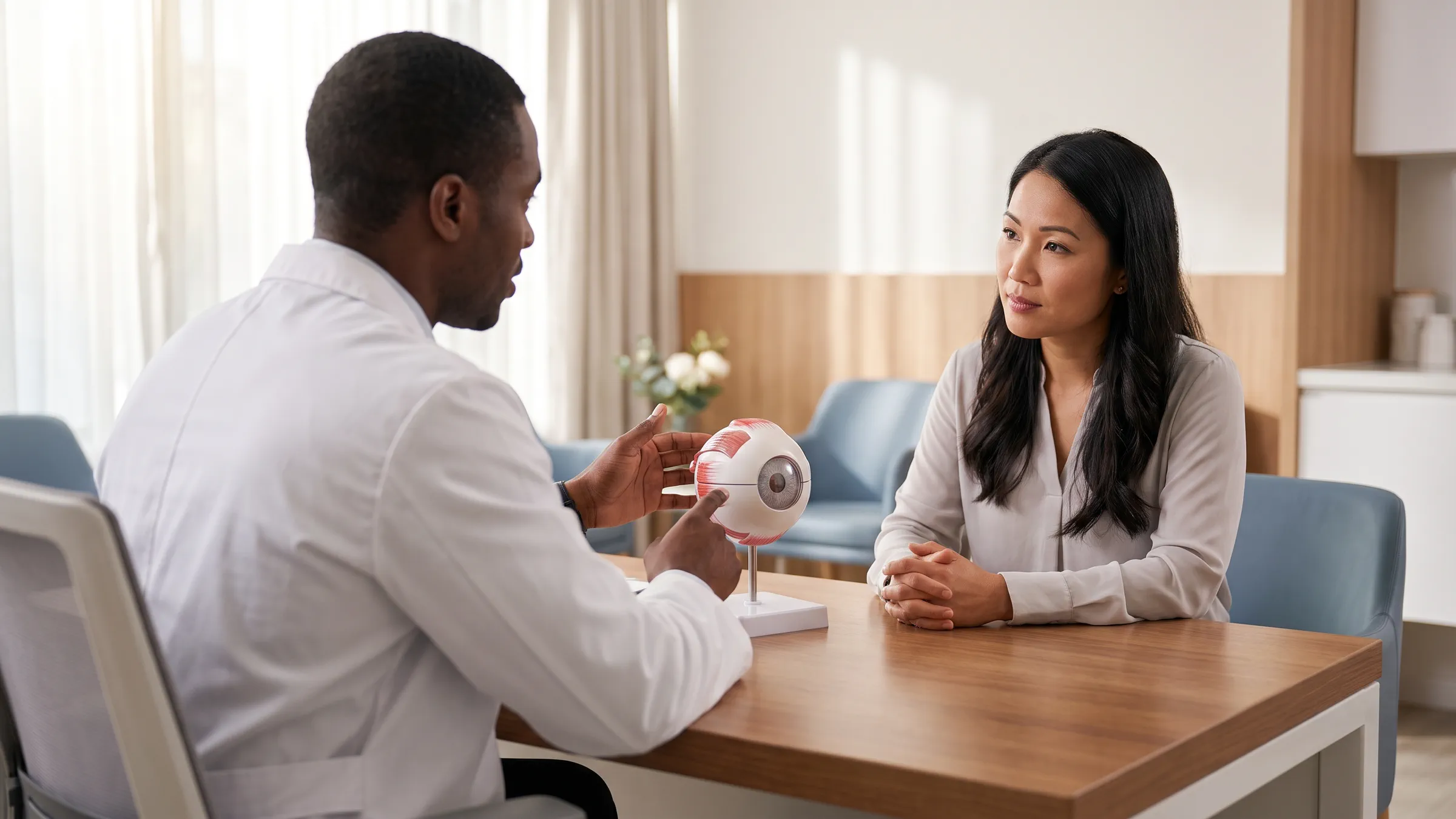

Ortho-K care lasts beyond the first week. Families want to know whether it keeps helping, what the doctor checks and what happens when wear stops. Long-term studies add useful evidence, but cannot predict one child's exact result.
Keep two goals separate: clear daytime vision and slower myopia progression. Each needs its own checks.
Sustained Myopia Control: Does the Effect Last?
A study looked at ten years of care. It compared 53 Ortho-K patients with 39 soft contact lens patients. These patients had stayed with care for ten years. The Ortho-K group had less change in their estimated lens power.
The researchers looked back at records. They did not assign people to groups by chance and track eye length for ten years. They used changes in lens power and the focusing error that remained. Read the ten-year study.
The two-year ROMIO trial did measure eye length. Average growth among completers was 0.36 mm with Ortho-K versus 0.63 mm with standard glasses. That was a 43% relative difference in the trial, not a forecast for each child. ROMIO study.
Ask what your child's measurements have done since the last visit. Clear vision alone does not show that progression has stopped.
Long follow-up is useful, but study design still matters. People who keep returning for years may differ from those who stop. Ask how many started, how many finished and why others left. A long record of people who stayed in care does not describe every person who ever tried the treatment.
Also check the outcome. A lens-power change is not the same measure as eye growth in millimeters. You cannot put the two on one scale and call one treatment the winner.
The Long-Term Safety Profile of Ortho-K
Long-term wear still needs eye health checks. An eighteen-year report found that corneal staining was the most common reported problem. In this test, a dye shows changes on the eye surface. The authors stressed the need to keep teaching safe care. Original report.
That report does not guarantee safety for every wearer. Tell your provider about difficult removal, missed wear, new medicines and changes in cleaning. Bring the lenses and supplies when asked.
Remove lenses and seek prompt eye care for pain, unusual redness, discharge, light sensitivity or sudden blur. Do not wait for a routine visit. FDA: lens risks.
At the founding location, a full replacement pair is purchased every two years. The provider also checks actual condition and fit. A damaged or poorly fitting lens may need attention sooner.
Short-Term Adaptation vs. Long-Term Stability
| Part of care | First fitting | Ongoing care |
|---|---|---|
| Vision | Check the early response and any fitting changes | Check daily tasks and new blur |
| Lens care | Learn handling and cleaning | Keep the routine and check lens condition |
| Eye health | Assess suitability and fit | Check for changes or problems |
| Childhood myopia | Record a starting point | Track eye growth over time |
The founding-location first-year myopia program includes twice-yearly eye-length checks and corneal maps. Ask what your location includes and how care works after year one. Program fees and inclusions.
What Happens When Ortho-K Is Discontinued?
The change in the cornea, the clear front of the eye, wears off when lens wear stops. You will need glasses or other lenses to see clearly. Get the new lens power measured. It may differ from the one you had years ago. FDA: Ortho-K.
Eye growth after lens wear stops is a separate question. A review found early signs of more eye growth after stopping in some studies. The research has not yet answered all the questions. Review of benefits, risks and stopping treatment.
Plan the change with your provider. Discuss glasses or another treatment, timing and follow-up. Read what happens when lens wear stops.
A View from Our Clinic: Following Progress Over Time
Care-planning example, not a patient result: A military family is moving. They ask for baseline and recent readings, lens details and the next review date. The new provider can use those records to continue care.
Keep the records and contact numbers you would need while away. Use the provider finder to locate participating practices.
Keep copies of the baseline tests and later results, not only the latest prescription. At a plan review, ask what changed, whether the wear routine has changed and when the next check is due. If your family moves, ask the new practice to review those records before deciding how to continue care. Long-term success includes keeping follow-up practical for the family.
Frequently Asked Questions
Does clear vision mean myopia has stopped?
No. It shows how the correction is working. Eye measurements over time show another part of the picture.
How long should treatment continue?
Review age, progression, eye health and care needs with your provider. Do not choose a stopping date only because a set number of years has passed.
Do studies prove a sleepSEE success rate?
No. These studies used their own patients and lens settings. They are relevant evidence, but not sleepSEE-specific trials.
What should we bring to follow-up?
Bring what the practice requests, plus questions about vision, comfort and care. Ask how the readings compare with earlier visits.
Dr. James Singletary, OD, FIAOMC
Dr. James Singletary is a licensed eye doctor. His main field is Ortho-K. He helps people see clearly without surgery. He also cares for children to help slow myopia, or nearsightedness. He created the sleepSEE Ortho-K program.
Medical Disclaimer
This article helps you learn about eye care. It is not personal medical advice, a diagnosis or a treatment plan. Ask a qualified eye doctor about your eyes and care. Do not use this page in place of that advice.