
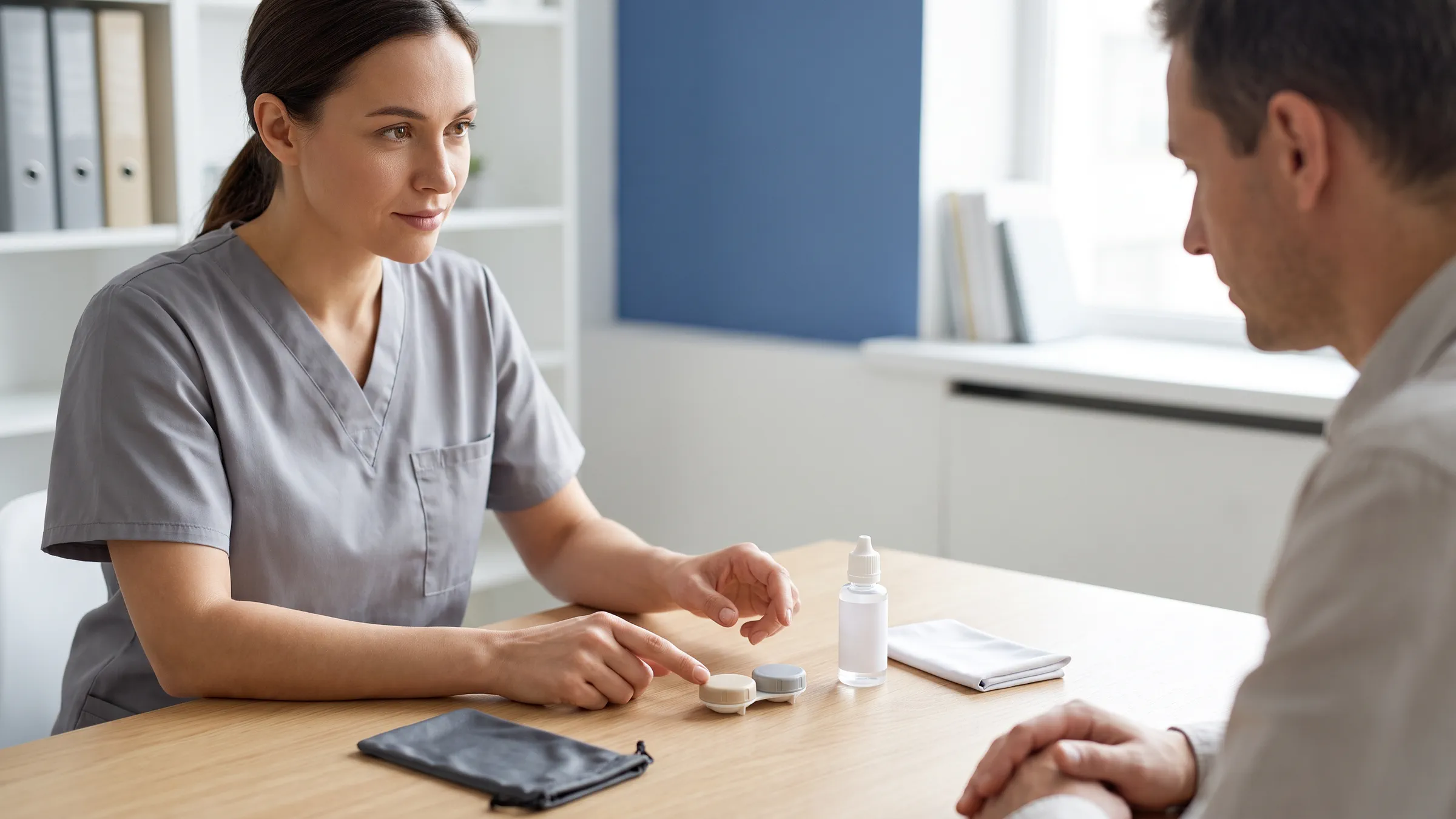
Ortho-K lenses are prescription medical devices. How you clean, handle and store them affects your eye health as well as your vision.
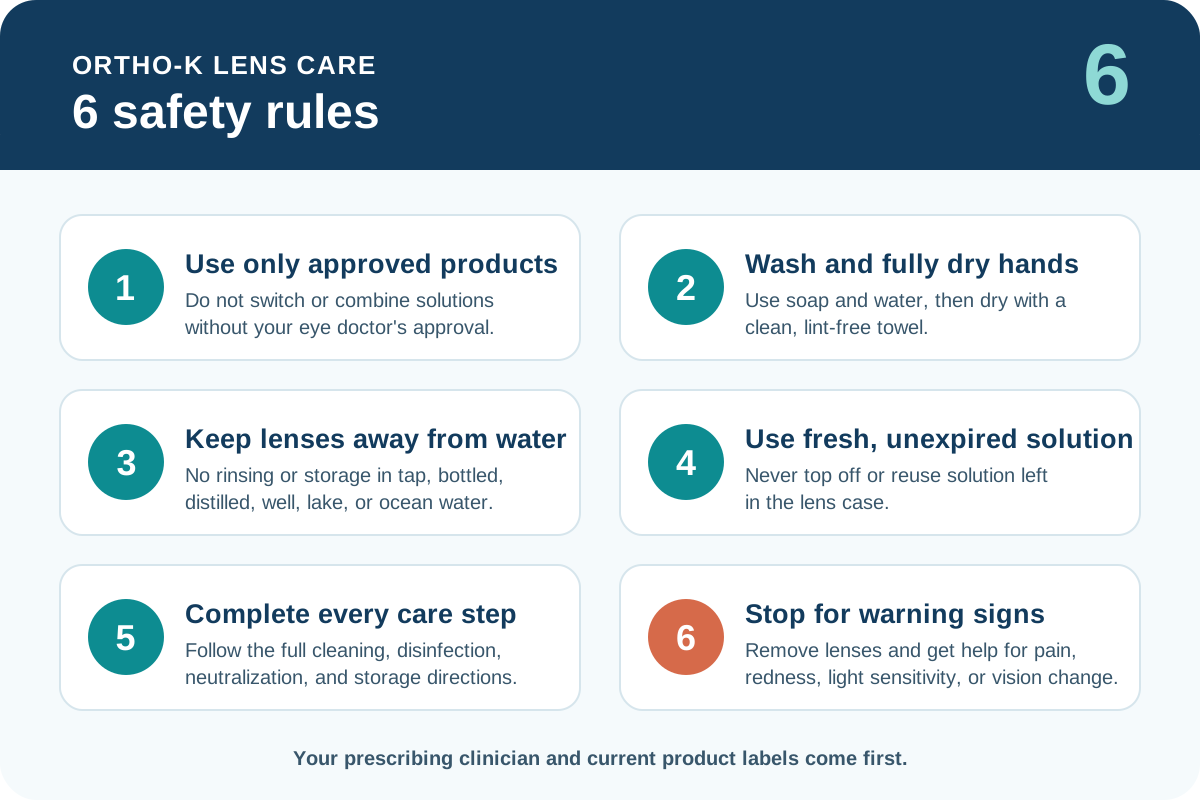
The six rules every Ortho-K wearer should know
Use only prescribed products.
Do not switch, mix or alternate solutions without your doctor's advice.
Wash and dry your hands.
Use soap and water, then a clean, lint-free towel. Keep lotion, oils and makeup away from lenses.
Keep lenses and cases away from water.
This includes tap, bottled, distilled, well, lake and ocean water. Remove lenses for showers, swimming and hot tubs.
Use fresh solution.
Check the expiry date. Never reuse old solution or top it up.
Complete every care step.
Cleaning removes deposits. Disinfecting reduces germs. Saline alone does not disinfect.
Act on symptoms.
Remove lenses and contact an eye doctor for pain, redness, light sensitivity, discharge or sudden blur.
Your daily routine
Use this as a checklist alongside your personal instructions. The prescribed products, steps and timing matter.
Prepare a clean workspace
Wash and dry your hands. Work on a clean, well-lit surface away from a sink or drain. Keep fingernails away from lenses. Handle the same eye first each time to avoid mixing the pair.
Inspect the lens
Look for chips, cracks, scratches, cloudiness or debris. Do not wear a damaged lens. Store it as directed and call the eye doctor.
Clean and rinse exactly as prescribed
Use only the approved cleaner, rinse product and method. If rubbing is part of the instructions, follow the label and the method taught at your fitting.
Follow all the steps. Do not use saline in place of the solution that kills germs. Saline is salt water. A bottle labeled “contact-lens solution” may still be wrong for your firm lenses.
Disinfect for the full required time
Use the correct case and fresh solution. Keep right and left lenses on the correct sides. Follow the full soak time on the label. Never add new solution to used solution.
Store lenses using your prescribed method
Storage varies by system. Some lenses must stay covered in an approved solution while not worn. Ask how to store them during the day, a missed night or a longer break.
Air-drying an empty case does not mean the lenses should be stored dry.
Care for the empty case
For a standard storage case, discard used solution after taking lenses out. Clean with fresh lens solution as directed. Let the empty case dry upside down, with caps off, on a clean surface.
Replace the case at least every three months, or sooner if your doctor or product says to. Peroxide systems need their own special case and instructions.
Before you leave training, show the staff the full routine with your own supplies. Ask them to check the order, the amount of solution and the timing. If a parent helps, that person should practice too. A written list is easier to follow when you are tired than a memory of the visit.
Keep the product labels. Similar bottles can have different jobs: cleaning, rinsing or disinfecting. Write down which one does each step in your plan. Ask the office before replacing a missing product with something that looks similar.
If you use a hydrogen-peroxide care system
Peroxide is one care-system option, not the best choice for every lens or person. It must be neutralized before touching the eye. Neutralizing changes the peroxide into a form that can be used as directed. Unneutralized peroxide can burn and damage the eye.
If your doctor approves this system:
- Use only its supplied neutralizing case.
- Use the new case with each bottle when the label says to.
- Fill and use it exactly as directed.
- Wait the full labeled neutralizing time.
- Never rinse a lens with unneutralized peroxide just before wear.
- Never put peroxide solution straight into the eye.
- Keep it in its labeled bottle, not an unmarked travel bottle.
If peroxide gets in your eye or causes a reaction, take the lens out if you can do so safely. Call your eye doctor for steps to follow. Get urgent care if pain or redness lasts, light hurts your eyes or you cannot see as well.
Water and Ortho-K lenses do not mix
Water can carry germs that cause serious eye infection. Keep lenses and cases away from all water, including showers and swimming.
If water touches a lens, remove it as soon as you can safely. Do not put it back in until you have followed the recovery and disinfection steps for your system. Call the office if unsure. Ask about goggles and backup correction for water activities.
If you drop a lens
Do not put it straight back on the eye. Use the handling tool or method your doctor taught you. Inspect it in good light. Do not wear a damaged or misshapen lens.
An intact lens still needs the full prescribed cleaning and disinfection process. Call for advice if it touched water, an unknown chemical or a dirty surface.
Warning signs: remove the lenses and get help
Get prompt eye-care advice for:
- Pain, burning or marked irritation.
- Unusual redness or light sensitivity.
- Discharge or excess tearing.
- A lasting feeling that something is in the eye.
- New or worse blur, halos or reduced vision.
- A lens that will not move or cannot be removed with the taught method.
Do not reinsert lenses until the eye doctor says it is safe. Infection can become serious quickly. Waiting for symptoms to pass is not a safe plan.
For a chemical splash, follow emergency first-aid directions, flush the eye as directed and seek urgent help. Remove the lens if possible. Emergency flushing is different from using water to clean or store a lens.
Quick decision table
| Situation | Next step |
|---|---|
| New solution wanted | Ask before switching or mixing products. |
| Water touched a lens | Remove it safely; follow the prescribed recovery and disinfection steps. |
| Lens looks damaged | Do not wear it; contact the office. |
| Pain, redness or vision change | Remove lenses and get prompt eye care. |
| Missed wear | Do not add wear to “catch up.” Use advised backup correction. |
| Care is not possible while away | Use backup glasses and call the office. Do not improvise. |
Travel checklist
Pack enough of the solution your doctor approved. Bring the right case, backup glasses and any lens tool your doctor gave you. Take your care steps and the doctor's phone number. Keep solutions in their own labeled bottles. Ask before you use a different product while away.
Frequently asked questions
Can I rinse lenses with tap water?
No. Use only the rinse product and method approved for your lenses.
Does saline disinfect lenses?
No. It may be used to rinse in some plans, but cannot replace disinfection.
Can I switch solutions?
Ask first. Not every product works with every rigid lens or care system.
How often should I replace the case?
At least every three months, or sooner as directed. Peroxide cases follow their own product instructions.
Can I wear lenses longer after a missed night?
Do not change wear time without advice. Use backup correction if needed.
What if the eye is red but does not hurt?
Remove the lens and contact the eye doctor. Do not keep wearing it until the cause is known and it is safe to resume.
The bottom line
Keep water away, use prescribed products and complete all steps. Keep eye checks and act on symptoms. If your care instructions are missing or your products have changed, call before the next wear.