Yes, some adults can have LASIK twice. A second surgery is often called an enhancement or touch-up. It can treat a prescription left after LASIK or one that comes back. First, your doctor must find the cause of the blur. Your vision must be stable. Your cornea must have a suitable shape and enough healthy tissue. An eye exam helps you compare surgery and other choices. FDA: suitability for LASIK research on repeat treatment
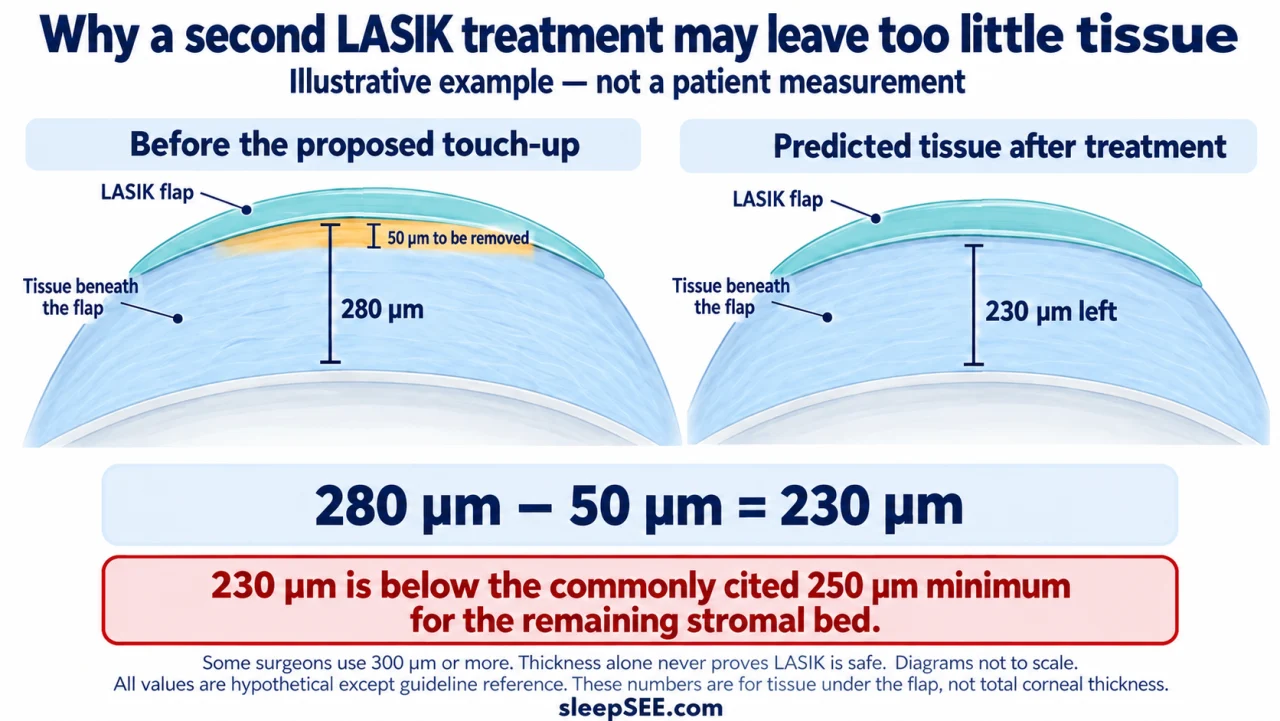 View full-size corneal thickness diagram
The tissue beneath the flap matters. In this example, 280 microns minus 50 microns leaves 230 microns after surgery. A micron (µm) is one-thousandth of a millimeter. These numbers measure tissue under the flap, not the whole cornea. A common lower limit is 250 µm, or 0.25 mm. Some surgeons use 300 µm or more. This example is below both. Thickness alone cannot prove that more surgery is safe. Repeat-LASIK study university surgical teaching, slide 32
You had LASIK so you could rely less on glasses. Now road signs look soft again, or reading takes more effort. Another operation is one possible path. It is not the only one.
This guide is for adults whose vision changed after LASIK. It explains more surgery and why the cause of blur matters. It also covers care without surgery, including sleepSEE Ortho-K.
What is a LASIK enhancement?
A LASIK enhancement is another eye surgery. It treats a prescription left after LASIK or one that comes back later. A touch-up is still invasive surgery. It removes more tissue from the cornea. The words touch-up and enhancement do not mean there is no surgery or no risk.
The surgeon may lift your old LASIK flap and use the laser again. Or the surgeon may suggest PRK. PRK treats the surface without lifting the flap. Your eyes and the risks of each method guide the choice. A second surgery does not always need a new flap. Study comparing flap-lift and surface treatment
Why has your vision changed?
Blur after LASIK does not always mean the same problem has returned. Finding the cause helps your doctor choose care that addresses it.
- Your distance prescription changed. Nearsightedness can return after surgery. Doctors call this myopic regression. Studies have looked at Ortho-K for this problem. Post-surgery Ortho-K study
- Your eyes are dry. Dry eye can affect vision and comfort. LASIK can cause or worsen dryness, so your eye surface needs attention before another procedure. FDA: LASIK suitability.
- Reading focus changes with age. The natural lens in your eye gets less flexible. This makes it harder to focus up close. The name for this is presbyopia. It can happen after LASIK too. Fixing distance vision does not stop eye aging. NEI: presbyopia
- A cataract is affecting the lens inside your eye. A cloudy lens can cause blur, glare, and trouble at night. More laser treatment on the cornea does not remove a cataract. NEI: cataracts.
Other eye problems can also cause blur. Call your eye doctor promptly if symptoms are new, unusual or getting worse after surgery. FDA: care after LASIK
Who can have LASIK again?
Having LASIK in the past does not mean more surgery is right for you. Your surgeon needs to check:
- Age and a stable prescription. Your eye measurements should stop changing before more surgery. Compare old and new prescriptions. Age or one exam is not enough.
- Corneal thickness and shape. The cornea is the clear front part of your eye. Its health matters. So does the tissue left after your first surgery.
- Dryness and eye health. Your eye surface may need care before you choose more surgery.
- What you want to improve. Blur far away, trouble reading, glare and halos are different problems. Halos are rings around lights. One treatment may not fix all of them.
Ask for the specific reason if another surgeon has turned you down. That reason also matters when considering contact lenses or Ortho-K. FDA: suitability, FDA: surgery checklist.
Does age matter for another LASIK procedure?
Yes, but no birthday proves your eyes are ready. The FDA says no LASIK lasers are approved for those under 18. The American Academy of Ophthalmology says patients should be at least 18, and ideally over 21. It also calls for little change in the prescription over the past year. These are general LASIK guides. They do not clear you for a second surgery. FDA: suitability AAO: LASIK
Vision can still change in your twenties. One study followed people from age 20 to 28. More than one-third became more nearsighted. The study did not test the best age for LASIK. It does not prove everyone should wait until 28. It does show why your own prescription history matters. Raine Study, 2022
How corneal scans help guide the decision
Corneal scans help the doctor check the shape and thickness of your cornea. They also help track changes and look for disease. One such disease is keratoconus, which makes the cornea thin and bulge. Tomography makes maps of the corneal surfaces. An OCT scan suited to the front of the eye can show its layers from the side. Tools and services vary by provider. Corneal imaging research on OCT flap and stromal-bed measurements
The whole cornea is thicker than just the tissue left under a LASIK flap. Before more surgery, the doctor must check the flap too. They must work out how much more tissue the laser would remove. Your vision history, eye health and goals also matter. A thin cornea does not mean Ortho-K is right for you. Research on estimating tissue before repeat LASIK
What is the risk if too little tissue remains?
The main concern is corneal ectasia. This means the cornea gets weak and bulges. Its shape can change and cause more blur. It can also cause irregular astigmatism, an uneven focus that glasses may not fully fix. This can start long after surgery. Taking more tissue from a weak cornea can make it worse. Clinical reference: ectasia after LASIK FDA: thin corneas and previous surgery
Our example leaves 230 microns of tissue under the flap. That is below the common lower limit of 250 microns. The surgeon should stop and check the plan again. It does not mean harm is certain. But being above 250, or even 300, does not promise safety either. Shape, tissue measurements and other risks still matter. Clinical reference: LASIK screening
A small change in prescription may need less tissue removed than the first surgery. It is still surgery on an eye that has already had treatment. The methods and risks can differ. Lifting an old flap can let surface cells grow under it. Surface treatment has its own healing risks. These include haze, or cloudy corneal tissue. Study comparing repeat-treatment methods
Why dry eye can pause the surgery decision
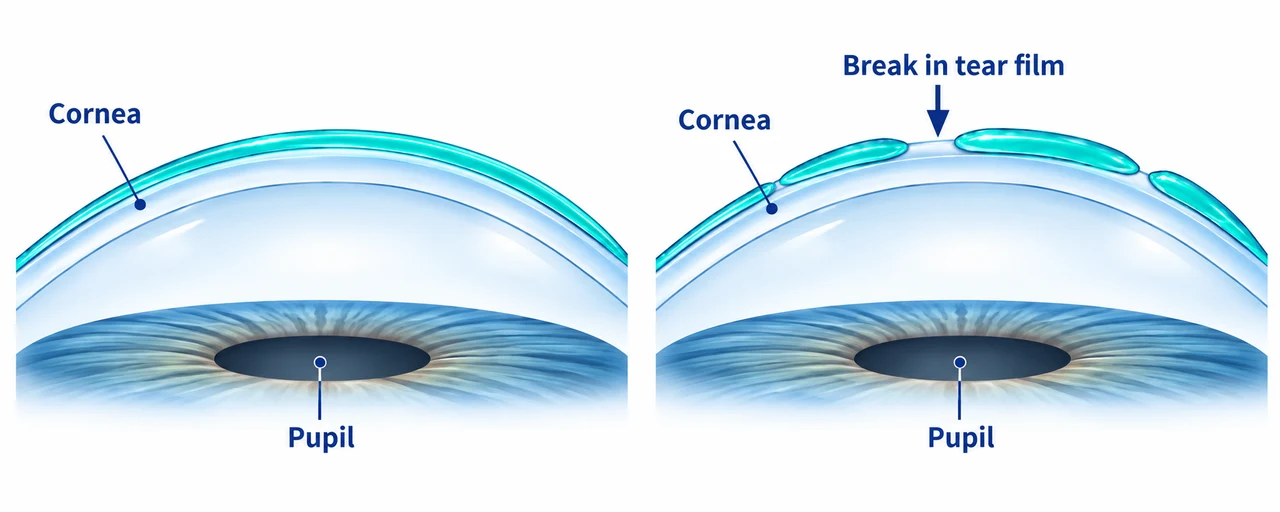
Left: an even layer of tears. Right: gaps in the tear layer. Tears help keep the eye surface smooth. Dry eye can cause blur and discomfort. LASIK can make dryness worse. Your doctor may treat dry eye before deciding about more surgery. This is a simple drawing. It does not diagnose dry eye or mean all dry eye rules out surgery for good. NEI: dry eye FDA: suitability
Three checks before choosing the next step
- Prescription: is it stable, and what is causing the blur?
- Cornea: what do the remaining tissue and shape show?
- Eye surface: does dryness need treatment first?
Your doctor puts these findings together. Then you can discuss surgery, glasses, daytime contacts or an Ortho-K exam. No one check can show that a choice is right for you.
How long should you wait?
Stable eye measurements matter more than a date. Before more surgery, the FDA advises checking your eyes at two visits at least three months apart. The results should be consistent. That does not mean everyone can have more surgery after three months. FDA: recovery and enhancement
If your LASIK was years ago, you still need a fresh exam. Your old results help explain your history; today’s measurements guide the next step.
What are your options?
Your doctor can help compare these paths once the cause of blur is clear.
| Option | What it can offer | What needs to be checked |
|---|---|---|
| LASIK enhancement | More laser treatment for a prescription that remains or comes back | Stable vision, enough healthy corneal tissue, suitable shape and surgery risks |
| PRK after LASIK | Surface laser treatment without lifting the old flap | A separate exam for surgery; surface healing and haze (cloudy tissue) risks |
| Glasses | Vision correction without surgery or lenses on the eye | The prescription and whether it gives the vision you need |
| Daytime contact lenses | Vision correction while the lenses are worn | A fit suited to your eyes after surgery, eye surface health and lens care |
| Ortho-K | Overnight lenses with the goal of clear vision through waking hours, without daytime glasses or contacts | A specialist exam, a good fit, lens wear as directed and follow-up care |
Lifting the flap and treating the surface have different risks. One study looked at 108 treated eyes. More eyes in the flap-lift group had surface cells grow under the flap. More in the surface-treatment group had haze. These results do not predict your own risk. Repeat-treatment study
Ask your surgeon about dry eye, glare, halos and possible vision loss. Sharper distance focus does not promise that glare or halos will improve. FDA: LASIK risks FDA: enhancement expectations
For a broader comparison, see LASIK alternatives.
What if your cornea is too thin for more LASIK?
You may still have choices with or without surgery. First, ask if your cornea is thin but stable. Or is it getting weaker and changing shape? That difference helps guide care. Being turned down for LASIK does not mean another treatment is right for you.
Nonsurgical options
- Glasses: These can correct a regular prescription without removing tissue. But glasses may not fully fix blur caused by an uneven corneal shape.
- Daytime contacts: Soft lenses may work for a regular prescription. Special rigid or scleral lenses may help if the cornea is uneven. Scleral lenses rest on the white of the eye and arch over the cornea. A specialist must fit them. They do not stop ectasia from getting worse. NEI: special contact lenses
- Ortho-K: Some people whose nearsightedness returns after LASIK can be checked for overnight lenses. These lenses do not remove tissue. But a thin cornea alone does not mean they will fit your eyes. Ortho-K does not strengthen a cornea with worsening ectasia. The small studies below do not prove it is safe for every thin or weak cornea. Post-LASIK Ortho-K study
- Dry-eye care: If dry eye causes some of the blur, treating it may help your vision and comfort. That care can come before choosing another way to correct your vision. NEI: dry eye
Surgery needs a separate exam
PRK after LASIK treats the surface without lifting the old flap. It still removes tissue. Healing problems and haze can occur. It may fit some eyes. It is not a way around every finding that the cornea is too thin or unstable. Study of repeat-treatment methods
A lens implant, such as an ICL, sits inside your eye. It can treat some prescriptions without using a laser to remove corneal tissue. This is still surgery. The surgeon checks the space for the lens and the cells lining the cornea. Your prescription and the device's approved uses matter too. Risks include cataract, eye pressure problems and loss of corneal cells. The lens does not repair ectasia. FDA: phakic-lens candidacy FDA: implant risks
Cataract surgery can treat blur from a cloudy natural lens. More laser treatment on the cornea cannot remove that cause. Lens replacement has its own exam and risks. It is not the default choice for a thin cornea. NEI: cataracts
If the cornea is getting weaker, address that first
If ectasia gets worse after LASIK, a corneal specialist may suggest cross-linking. This treatment aims to help stop the cornea from getting weaker. It does not promise vision without glasses. It also does not make more LASIK safe by itself. You may still need special lenses to see clearly. Clinical trial evidence on cross-linking
Can Ortho-K help after LASIK?
Ortho-K may be worth discussing if your nearsightedness returns after LASIK. Only some eyes are suited to it. Ortho-K is short for orthokeratology. Custom lenses change the cornea's shape for a limited time. Wear them during sleep and take them out on waking. The goal is clear daytime vision without daytime glasses or contacts.
Ortho-K does not remove more corneal tissue. Keep wearing the lenses on your doctor's schedule to keep the effect. The vision effect can reverse when lens wear stops. Harm from a lens problem may not reverse. Post-LASIK Ortho-K research
What does the research show?
A 2015 study followed 12 people with 21 treated eyes. Their nearsightedness had returned after vision-correction surgery. Vision without glasses improved with Ortho-K. The study followed them for about a year. Read the study
A 2025 study looked at 14 people with 26 treated eyes. They had LASIK more than ten years earlier. The study tracked Ortho-K use for 30 months. It checked the cornea and the LASIK flap. The authors reported encouraging results. Read the study
Both studies were small and involved selected patients. They support looking at this option. They do not prove it fits every eye after LASIK. They also cannot rule out rare problems.
sleepSEE's post-LASIK program starts with an eye exam. The provider checks your prescription, corneal measurements and eye health. Those checks help show if lenses can be fitted. Being unable to have more LASIK does not mean Ortho-K is right for you.
Overnight lenses need careful cleaning, handling and checkups. Lens wear carries a risk of infection. Ask about the lens your provider plans to use. Ask what its FDA labeling says and how that applies after your surgery. FDA: contact-lens risks
Learn about night contacts and their routine.
What does post-LASIK sleepSEE care cost?
Fees vary by provider and by the care your eyes need. Ask for a written quote for the post-LASIK exam and lens fitting. The founder's box above gives one local fee example.
Ask which lenses, fitting visits and checkups the fee covers. Ask about costs after year one too. Supplies and care outside the program cost extra. sleepSEE costs and payment details
More surgery is a different service. Ask the surgeon for a written quote. Check any terms from your first surgery package. A touch-up is not always free.
What should you ask at your exam?
Bring your old LASIK records if you have them, your current glasses, and a list of symptoms. These questions can help:
- What is causing my blur? Is it my distance prescription, dry eye, reading focus, or something else?
- What do my corneal measurements show?
- What would more surgery improve, and what would it leave unchanged?
- Could glasses, daytime contacts, or Ortho-K meet my goals?
- If you recommend Ortho-K, what makes my post-LASIK eyes suitable?
- What costs, follow-up visits, and care steps should I plan for?
To explore sleepSEE, find a provider and ask for an evaluation for vision changes after LASIK. The exam determines whether the program fits your eyes.
Common questions
Can you get LASIK twice after ten or twenty years?
Sometimes. Time alone does not answer the question. Your current prescription, corneal health and cause of blur all matter. Start with a new eye exam. FDA: suitability
How many times can you get LASIK?
There is no set number for everyone. Each surgery changes the cornea. The surgeon must check if enough healthy tissue remains. One touch-up does not mean you can have another. FDA: LASIK risks
Will a second LASIK procedure stop me needing reading correction?
No. A second LASIK surgery will not stop the loss of near focus as you age. Reading glasses, contacts or other choices can help you manage it. No vision-correction procedure stops eye aging. None promises the same vision for life or that you will never need glasses. NEI: presbyopia
Can I choose Ortho-K even if I could have more surgery?
Yes, you can ask to compare both. Your choice matters. Ortho-K also needs a suitable lens fit. A provider who treats eyes after surgery can check if it is an option for you. Research on Ortho-K after refractive surgery
Is Ortho-K Right for Me?
Considering Ortho-K after LASIK? Get the free guide to help prepare for your evaluation.
- Learn what the eye exam checks.
- Plan for work, reading, night driving, travel and shift work.
- Plan costs with a five-year example and worksheet.
- Explore the first month, lens care and six questions for your doctor.

Is Ortho-K Right for Me?
8-page PDF · Fill in or print